
Active Release Techniques
Faster recovery with Active Release Techniques
A strong, healthy, flexible, and pain-free body feels great to live in!
That starts with a well-functioning musculoskeletal system — especially your soft tissue: muscles, tendons, ligaments, nerves, and fascia.
You can do a lot yourself to keep these healthy: eat well, sleep enough, move regularly, and challenge your body to grow stronger and more resilient.
But sometimes, you hit a point where self-care isn’t enough.
You may feel pain, stiffness, loss of strength, stability, or endurance — and no matter what you try, it doesn’t really go away.
That’s when it’s time to get help.
You’re in the right place.
As physiotherapists, we treat a wide range of musculoskeletal complaints — issues affecting the body’s movement system.
When it comes to treating and maintaining soft tissue health, Active Release Techniques (ART) is one of the best methods available today.


ART isn’t just used in individual healthcare — hundreds of companies worldwide benefit from on-site Active Release Techniques programs.
In workplaces that offer ART, musculoskeletal-related costs have been shown to drop by 50–80% — a major cost reduction.
Even best-selling author Tim Ferriss recommends ART as one of the most effective ways to treat injuries.
At Art of Physio, we specialize in this method.
Our founder, Pieter, is one of Europe’s lead instructors for ART and teaches several courses each year to other practitioners across Europe.
There are currently only about 15 certified ART providers in the Netherlands — surprisingly few for such an effective method.
On this page, you’ll learn what ART is, how it works, and how it can help you stay strong, flexible, and pain-free.
What is Active Release Techniques (ART)?
The founder of ART, Dr. Mike Leahy, has an interesting background.
Before becoming a chiropractor, he worked as a fighter and test pilot in the U.S. Air Force and was trained in engineering.
When he began practicing chiropractic care in 1984, he noticed that spinal adjustments alone didn’t resolve many of his patients’ problems.
He started studying the relationship between soft tissue and pain complaints.
Drawing on his engineering background, he compared the body’s mechanics to physical laws — and saw remarkable parallels.
That was the beginning of ART.
The results with his clients — often top athletes and high performers — were so strong that he was soon asked to teach others.
Now, over 30 years later, ART has grown into a worldwide training institute with tens of thousands of certified practitioners.
Most are based in North America, but the number in Europe is steadily increasing.
To become certified, practitioners must pass both a written and a practical exam — and recertify annually to maintain their credentials.
To remain truly state-of-the-art, the ART organization includes an active research and development department.
In spring 2025, for example, a new course focused on fascia (connective tissue) will be introduced.
Many methods have borrowed parts of the ART concept and renamed it, but few invest the same time, energy, and resources into continuous development.
That’s the background of ART —
but what exactly is it?
What ART Does
Active Release Techniques is a patented soft-tissue treatment method that targets problems within and between muscles, tendons, ligaments, fascia, and nerves.
To understand how ART works, it helps to look at how injuries develop and what processes are involved.
The Cumulative Injury Cycle
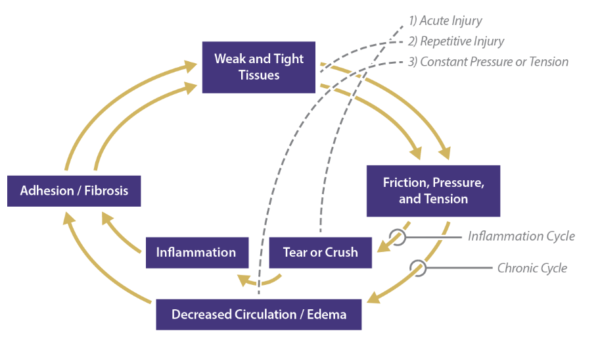
The Cumulative Injury Cycle shows how different types of injuries can begin and progress.
Injuries can develop in three main ways:
- Acute injury
- Repetitive strain
- Constant pressure or tension
1. Acute Injury
When you experience an acute injury — such as a tear, strain, or impact — an inflammatory response begins (see image).
Inflammation kick-starts your healing process by creating scar tissue — the “good stuff” that reconnects damaged fibers.
However, sometimes excess scar tissue forms, causing layers to stick together when they shouldn’t.
This can happen within a muscle, between muscles, or even between a muscle and a nerve.
These sticky areas are called adhesions, made up of collagen fibers.
Healthy muscles behave like bundles of elastic bands that shorten, lengthen, and glide smoothly along each other.
The more adhesions develop, the less internal glide is possible — leading to stiffness and loss of strength.
Restricted tissues experience higher internal friction, pressure, and tension, reducing circulation — like squeezing a sponge.
Poor circulation means less oxygen (a state called hypoxia), which in turn creates chemical changes that trigger even more adhesions.
And so, a vicious cycle begins.
2. Repetitive Injury
Repetitive movements — especially small, repeated motions — create chronic tension in the muscles.
Nearby tissues such as fascia, nerves, and ligaments can also become tight, restricting the entire area.
That’s why small, localized issues often spread over time.
If internal tension becomes high enough, even without an external force, acute inflammation can occur.
3. Constant Pressure or Tension
Constant pressure or compression is the third way to enter the cumulative injury cycle.
We know that sustained pressure reduces circulation, which triggers all the downstream effects described above.
ART breaks this cycle by targeting and releasing adhesions and fibrosis.
As the tissue becomes more supple and circulation improves, healing accelerates and pain decreases.
Because each tissue has its own place and structure in the body — and trained hands can distinguish between them — ART allows for highly specific, efficient, and fast results.
How ART Works on a Tissue Level
Muscle tissue is made of collagen and elastin, giving it flexibility.
Adhesions, however, are made almost entirely of collagen fibers — they don’t stretch.
By taking a tissue to its full stretch and then adding targeted tension, adhesions have nowhere to go — and they break down.
Both therapist and client can feel the tissue soften and move more freely.
That’s the release in Active Release Techniques.
- A typical ART treatment pass includes these steps:
- Shorten the tissue.
- Apply the correct depth and tension with the hands.
- Move the tissue through its full range (stretch).
- Maintain the tension until the release occurs.
The Unique Aspect of ART: Treating Nerve Entrapments
One of the most distinctive features of ART is its ability to treat nerve entrapments.
For nerves to function well, they must glide freely through and along surrounding tissue — and they don’t like compression.
When nerves can’t glide or are under constant pressure, they become irritated.
Typical symptoms include:
Tingling
Numbness
Weakness
Localized pain
Common examples are sciatica, carpal tunnel syndrome, and thoracic outlet compression.
When other treatments or training fail to help, a nerve entrapment may be the hidden cause.
Using ART’s nerve protocols, the therapist can assess where the nerve is restricted and help mobilize it.
Benefits of ART Compared to Other Treatments
Think of trigger point therapy or traditional massage.
Regular (physio)massage mainly reduces tension within a muscle but doesn’t do much to improve tissue glide — how different layers move relative to each other.
That’s exactly where ART makes the difference.
Once tissues can glide freely again, tension decreases while strength and function improve.
That’s why ART often achieves significant results within just one or two sessions — reducing pain and improving mobility quickly.
Frequently Asked Questions
Who Is ART For?
People with work-related issues (RSI, stiffness from sitting long hours)
Athletes with sports injuries or those wanting to enhance performance
People with chronic neck or back pain
Post-surgery patients
Anyone who wants to maintain mobility and prevent injuries
What Can I Expect During an ART Session?
An ART session feels similar to a targeted sports massage — specific, focused, and dynamic.
How Often Should I Get ART?
At Art of Physio, a typical program lasts 6–8 sessions, depending on the type of injury.
We always aim for noticeable improvement within two sessions.
Is ART Painful?
If there’s a problem in the tissue, treatment can feel intense, but most people describe it as a good kind of pain — like a firm sports massage.
You’ll feel the tissue releasing, your movement becoming freer, and your discomfort decreasing.
Mild soreness afterward is normal and should fade within a day.
Is ART Covered by Insurance?
Your ART session at Art of Physio is billed as physiotherapy.
Depending on your insurance plan, a portion of the treatment costs may be reimbursed.
Reviews


